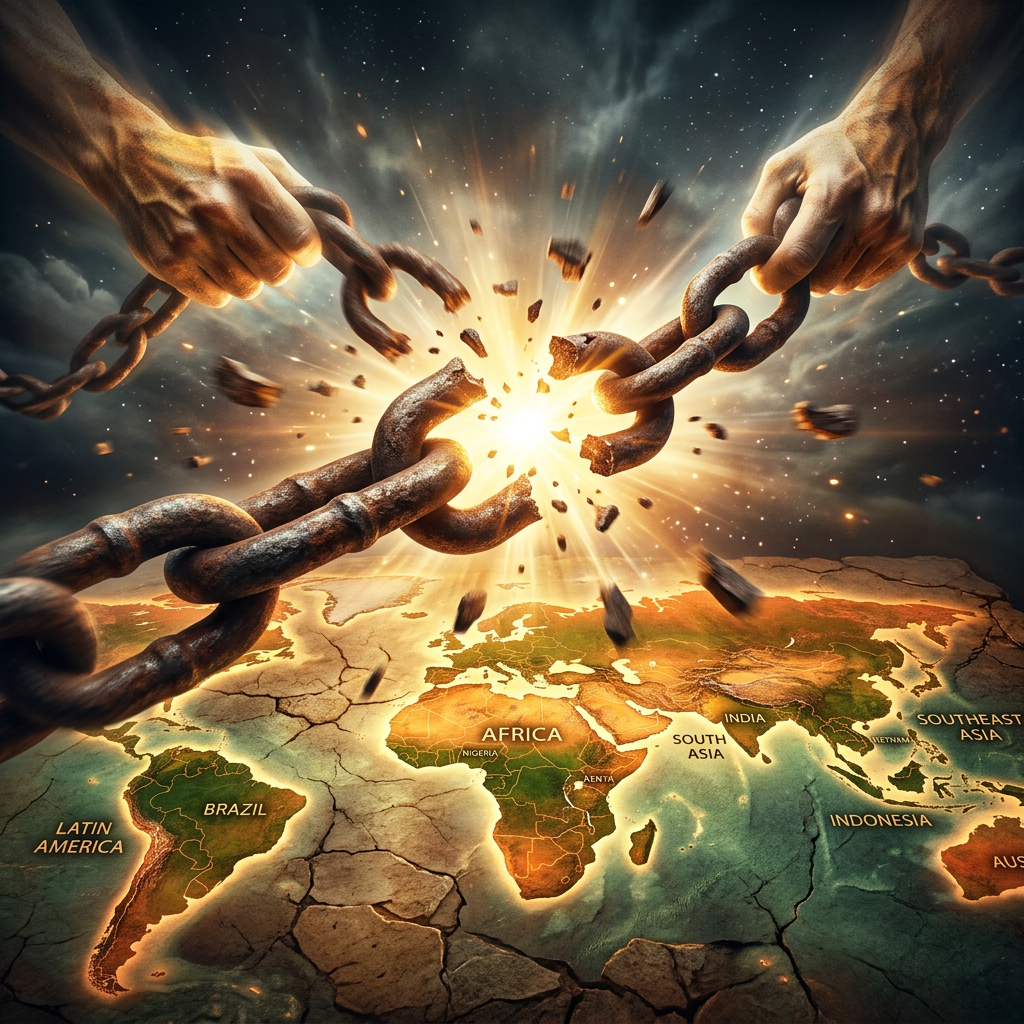
It is the opinion of many that colonisation is dead, with its effects diminished and gone. This notion is unfortunately untrue, as the effects of colonisation are prolific in the modern world. The aftermath of colonisation has manifested itself in several areas such as peacebuilding, humanitarian aid, promotion of rights and international development. This analysis will focus on the decolonisation of international development/aid in order to formulate suggestions that may help decolonise the practice.
An assumption that is frequently made is that poorer states, especially in Africa, are in need of help and assistance from rich states in the West. However, this perpetuates the colonial view that these nations cannot organise and effectively run themselves. Constant intervention from states in the West is certainly one of the main factors that has led to lower economic development in these areas. “By giving too much help, we postpone the acquisition of effective behaviour and perpetuate the need for help” (Skinner, 1996). Skinner perfectly describes how intervention leads to dependence as states don’t receive a chance to organise their systems and formulate policies in their own way. They are effectively forced into following the will of the West in order to receive assist, creating a dangerous cycle. Smilak and Putnam (2022) find that states with “high mortality rates are correlated with poorly developed social and economic infrastructure” due to being “previously colonized” and exploited. European settlers had no need to develop stable political system in the states they colonised, creating the modern instability present now.
Some scholars may argue that Western intervention is necessary, as this is the ‘moral’ thing to do. If one state is prosperous, surely it should assist states that are labelled as ‘failing’. The problem with this notion is that intervention tactics and goals are formulated by rich Westerners who have little knowledge surrounding local cultures and systems. Robtel Neajai Pailey (2020) grew up in the US before landing a position at the “African Development Bank Group”. It was during her time her that she became familiar with the advantages and privileges of being white and/or Western. As a black woman, it was “frustrating” for her to see that white ‘experts’ were immediately given priority and power over local African experts who had more knowledge and experience. She points to an instance when “Tony Blair’s African Governance Initiative (AGI) deployed mostly white British early- and mid-career bureaucrats to Liberia to serve as ‘governance advisors’ to our senior-level managers with decades more experience”. This proves that the colonial ‘race’ hierarchy is still present within international development. Africans are not given the agency they deserve over their own territories.
An obvious suggestion would be to transfer the final decision making to the local officials, experts and policy makers. Currently, development projects are severely mismanaged. Ika (2012) notes that development “teams have strayed too far from guidelines (e.g., a bidder is ineligible or lacks the qualifications to undertake the assignment, or was previously engaged in prohibited practices); there is inadequate planning of a task; or nonconformance with project plans”. Because the West funds these projects they decide who completes them, however they appear to have distrust in African groups to successfully carry out their plans. This further perpetuates colonial views that non-whites do not have the skills or capabilities that whites possess. Western organisations and states need to treat people in the Global South with respect, giving them trust to lead themselves and maintain control over their own development. Ake (1996) describes how years of ‘development’ in Africa has “yielded meager returns” with African economies “stagnating or regressing”. There is bountiful evidence that suggests Western plans for development do not work, giving more incentive to step back and give agency to the Global South.
While is it important to decolonise international development, it is essential to do it in the correct manner. Scholars assist politicians and organisations in their understanding of development and are essential in pushing the debate. However, “there is a concerning possibility that Northern academics who are interested in intellectual decolonisation may enact intellectual colonisation rather than dismantle it”. It is a worry that the decolonisation of academia is “superficial”, meaning it is done for the benefit of academics rather than for the benefit of developing states (Moosavi, 2020). This concept can be applied to the politicians responsible for decolonising development as they may only be attempting to decolonise to make themselves appear more favourably. The most dangerous aspect of Western knowledge is that it has been extremely influenced by colonialism. B.S. Cohn (1996) writes that “in certain important ways, knowledge was what colonialism was all about”. The history of colonialism and how the modern world has formed is all seen through the lens of the coloniser. The Western imperialist powers have had a monopoly on knowledge production and political theory for centuries. For these reasons, attempts to decolonise development will be done through a colonial lens.
To ensure that decolonisation in development is effective, I believe an appropriate solution would be to allow scholars and academics from the Global South to be at the forefront of the discussion. Their voices and ideas have been looked past for centuries. Development plans are formulated with colonial knowledge rather than with the knowledge of people who most understand how to decolonise. It is not good enough to simply ask the Global South to lead their own development using the Western template. I suggest that considerable funds should be given to universities and scholars in the Global South in order to fund research. This should be done over an extended period of time so that underdeveloped states are able to determine for themselves how they intend to develop. Knaus et al (2022) note that “when countries overthrew their colonial rulers, the infrastructures, particularly in education, remained”. Therefore, results cannot be expected immediately. The West has caused the colonialisation of universities in areas such as Africa and should allow these states time to fix the problems that imperialism has caused.
“There is a great deal of personal transformation that must be undergone by socially privileged individuals who decide to join in progressive work towards radical social action alongside marginalised groups or peoples” (Straubhaar, 2014). To encourage these suggested changes in the Global South, the Global North needs to eradicate what is known as the ‘white saviour complex’. The white saviour complex refers to the belief amongst white people that they are obliged to help developing nations due to their favourable characteristics. Sometimes it may be a subconscious belief, yet they see themselves as intelligent, rational and capable and see other ethnicities as less intelligent, illogical and incapable. The ‘white saviour’ “demonstrates their virtue by protecting or otherwise assisting a person of colour” (Rodesiler and Garland, 2019). While it may seem like a duty for many in the West, I suggest considering abandoning international development altogether. It is not the duty of the West to keep imposing their assistance on the Global South. Perhaps if the ‘white saviour complex’ was overcome it would be understood that the Global South may not need assistance. The West has continued to do more damage than good since colonialism, proving it is ineffective at brining successful development.
To conclude, it is clear that colonialism has affected the modern today to a large extent. Colonial attitudes are far too common, and it has resulted in lacklustre success in international development. Perhaps the most important suggestion made in this analysis is to lessen the amount of international development/aid altogether. On the surface it seems counterintuitive, yet the track record of the West has proven that the methods currently in action are not suitable. Local experts and organisations need to be given more agency as they have a far more advantageous position to achieve proper development. Not only because it may achieve successful development, but because it is their communities and their decision.
Bibliography
Ake, C. (1996). Democracy and development in Africa. Washington (D.C.): The Brookings Institution.
Cohn, B.S. (1996). Colonialism and Its Forms of Knowledge: The British in India. Princeton University Press.
Ika, L.A. (2012). Project Management for Development in Africa: Why Projects are Failing and What Can be Done about It. Project Management Journal, 43(4), pp.27–41.
Knaus, C.B., Mino, T. and Seroto, J. (2022). Decolonising African higher education : practitioner perspectives from across the continent. New York, NY: Routledge.
Moosavi, L. (2020). The decolonial bandwagon and the dangers of intellectual decolonisation. International Review of Sociology, 30(2), pp.332–354.
Pailey, R.N. (2019). De‐centring the ‘White Gaze’ of Development. Development and Change, 51(3).
Rodesiler, L. (2019). Supremacy with a smile: White saviour complex in ‘The Blind Side’. Screen Education, (92).
Skinner, B.F. (1996). The ethics of helping people. Finding solutions to social problems: Behavioral strategies for change., pp.61–72.
Smilak, N.R. and Putnam, R.F. (2022). A Critique of Colonialism and Modern Aid in Africa: What Would Skinner Say? Behavior and Social Issues, (31), pp.252–271.
Straubhaar, R. (2014). The stark reality of the ‘White Saviour’ complex and the need for critical consciousness: a document analysis of the early journals of a Freirean educator. Compare: A Journal of Comparative and International Education, 45(3), pp.381–400.
 Jopinions
Leave a comment